
Are there easy ways to improve your next vacation?
ristian Jarrett has a long interesting piece on vacations in The Psychologist. There are a number of interesting highlights, including the optimal length of a trip: ...people on mid-length holidays of between three to six days tended to report more positive mood than those on shorter or longer trips. ‘Possibly a two- to six-day holiday trip is long enough to enjoy (unlike a two-day trip),’ Nawijn surmised, ‘but short enough to minimise arguments with partner, family or friends.’ There's often…
3 minutes

Does guilting people really work?
minding people of their transgressions causes them to improve their behavior: People’s desires to see themselves as moral actors can contribute to their striving for and achievement of a sense of self-completeness. The authors use self-completion theory to predict (and show) that recalling one’s own (im)moral behavior leads to compensatory rather than consistent moral action as a way of completing the moral self. In three studies, people who recalled their immoral behavior reported greater participation in moral activities (Study 1),…
1 min read

Is nepotism more common than you think?
om a post by Miles Corak, via the Twitter feed of Tim Harford, author of the excellent book "Adapt: Why Success Always Starts with Failure": The bottom line is that about 40% of us have at some point worked for exactly the same firm that at some point also employed our fathers. But if dad’s earnings put him in the top 25% these chances are above average, they start taking off if dad was in the top 5%, and reach…
1 min read

How do siblings shape your personality?
borah Kotz has an interesting piece in the Boston Globe that highlights research findings from the new book The Sibling Effect: What the Bonds Among Brothers and Sisters Reveal About Us: Firstborns and only-children, for example, have a 3-point higher IQ on average compared with those born second, according to 2007 Norwegian study cited in the book, and second children are about a point ahead of those born third... And: Parents can devote 100 percent of their child-raising resources to the first child until they must…
2 minutes

Children Don’t Make Us Happier
can't think of many things that go more against popular opinion but the research says no: This meta-analysis finds that parents report lower marital satisfaction compared with nonparents (d=-.19, r=-.10). There is also a significant negative correlation between marital satisfaction and number of children (d=-.13, r=-.06). The difference in marital satisfaction is most pronounced among mothers of infants (38% of mothers of infants have high marital satisfaction, compared with 62% of childless women). For men, the effect remains similar across ages…
2 minutes

Parent-Teacher Conferences Have Nothing To Do With Children
cording to the researcher quoted at Newswise, parent-teacher conferences are much more about parents trying to prove "they're a good parent" -- even if that means throwing their kids under the bus: “Parents and teachers behave in a way suggesting that they are each treating the conference as an occasion for their own performance review – using the student’s progress, or lack thereof, as a gauge of how the teacher is doing at his or her job of ‘being a…
1 min read

Parents Do Have Favorite Children
om Time Magazine, via Robin Hanson: 65% of mothers and 70% of fathers exhibited a preference for one child, usually the older one. … “The most likely candidate for the mother’s favorite was the firstborn son, and for the father, it was the last-born daughter.” Join over 151,000 readers. Get a free weekly update via email here. Related posts: 6 Hostage Negotiation Techniques That Will Get You What You Want How To Get People To Like You: 7 Ways From An FBI…
1 min read
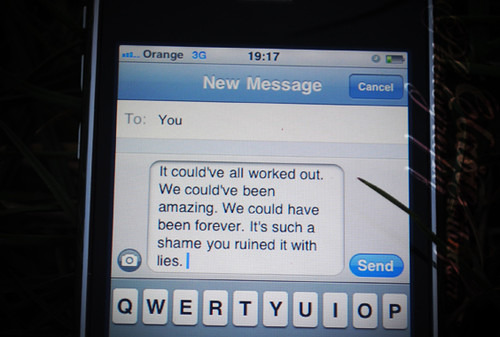
Who do we tell the most lies to? How do we tell them?
tell the most lies to the people we feel closest to. An online diary study was performed to investigate deception across different media. One hundred and four individuals participated in the study, with 76 completing the diaries. Individuals were most likely to lie on the telephone. Planned lies, which participants also rated the most serious, were more likely told via SMS (short message service) text messaging. Most lies were told to people participants felt closest to. The feature-based model…
1 min read
