How To Live A Good Life: 6 Secrets From Ancient Wisdom
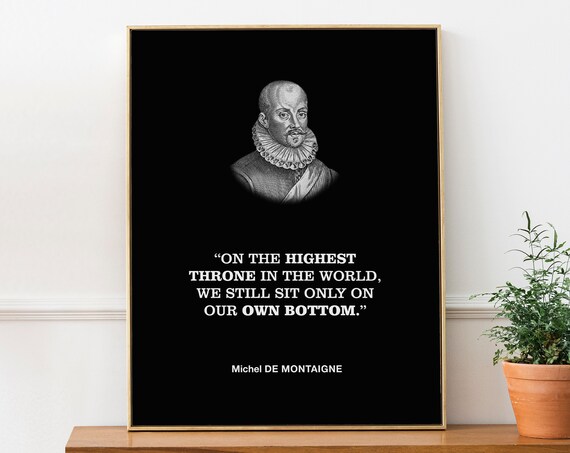
To say Michel de Montaigne had a run of bad luck would be a massive understatement.
First his best friend dies, probably of the plague. Then his father passes away from a kidney stone. Then his younger brother is killed by a tennis ball. Then Montaigne’s firstborn dies at two months old, the first of five kids he’ll bury.
No, we’re not done. Around the same time, one of his servants came thundering down a path on a giant workhorse and smashed into him. Montaigne nearly died himself.
After all this, what did he do?
He quit his job and locked himself away in a tower. (Of course he had a tower. Noblemen in the Renaissance didn’t just say, “I need space,” and go sit in a Honda Civic eating fries.)
But that didn’t work out so well either. He thought he was entering solitude. What he actually entered was himself. That’s terrifying. I’ve met myself. I do not recommend prolonged exposure.
Alone in the tower, his brain started working overtime. He couldn’t stop the flood of thoughts.
So he started writing it all down. This led him to accidentally invent the personal essay. You might even say he also invented blogging, four hundred years early, minus the pop-ups begging you to subscribe to a newsletter. (BTW, subscribe to my newsletter.)
In 1580, this guy published essays about friendship, death, conscience, education, politics, cruelty, and the limits of reason. Great. Put those on the syllabus. He also wrote about his farts, his kidney stones, his cat, and his opinions on radishes. There’s a whole passage about how male anatomy routinely ignores direct orders from management.
Montaigne became a legend by admitting he was a typical human being. He called the book Essais, which means “attempts.” (That’s also an accurate title for my twenties and my relationship history.) The book has been in print for four and a half centuries and stands as one of the most durable how-to-live manuals ever produced, written by a man whose primary qualification was admitting he had no idea how to live.
So today we’re going into the tower with him. We’re going to sit at the feet of a guy who wrote about his own gas and see what one of the all-time greats can teach us about living a good life.
We’ll be drawing on “Essays” by Michel de Montaigne and “How to Live” by Sarah Bakewell.
Let’s get to it…
Ask “What Do I Know?”
Que sais-je? was Montaigne’s motto. Translation: What do I know?
Montaigne wrote during the French Wars of Religion, when Catholics and Protestants were demonstrating their superior relationship with God by murdering one another in bulk. He noticed the single ingredient every killer had in common: certainty.
Nobody’s ever committed an atrocity while saying, “Honestly, I could be wrong about this.”
Hence, his motto “What do I know?” It keeps you humble and open-minded. It allows you to change your mind and apologize. And research shows this kind of intellectual humility might even make you better at predicting the future.
In a previous post we discussed Phil Tetlock’s superforecasters, those people who are able to outpredict professional intelligence analysts by ~30 percent. One of their secrets?
They stay humble. Unlike most experts, they’re willing to change their minds. They practice a statistical version of Que sais-je?
(To learn how to keep your brain sharp as you age, click here.)
So Montaigne knew the limits of his knowledge. But what about emotions?
Swap Bad Feelings
These days you’re told to treat every feeling like it’s some wise messenger from your deepest self. Even if it’s painful, you must sit with it, explore it, invite it in, follow its Substack.
Montaigne disagreed.
In “On Diversion,” he said: “Some painful idea gets hold of me; I find it quicker to change it than to subdue it. If I cannot substitute an opposite one for it, I can at least find a different one. Change always solaces it, dissolves it and dispels it. If I cannot fight it, I flee it.”
Harvard’s Daniel Wegner found evidence for a similar principle with the most famous polar bear in psychology. Yeah, you know this one. You tell your brain not to think of a white bear and it immediately becomes a white-bear breeding program.
But the half of Wegner nobody quotes is his finding that focused distraction does help us clear unwanted thoughts. The brain isn’t good at following “stop” orders but it’s a big fan of “look at this instead.”
When negative feelings threaten to overwhelm you, distract yourself. After the initial onslaught dies down, then you can explore them. Montaigne was prescribing top-shelf psychological advice at a time when everybody else was bleeding patients.
(To learn how to overcome negative thoughts, click here.)
But what about when the emotions pile up? When the stresses of life hit us from all sides?
Have A “Back Shop”
We’re always being told to give everything 100%. Montaigne had a different idea: don’t give anything all of you.
“We must reserve a back shop all our own, entirely free, in which to establish our real liberty and our principal retreat and solitude.”
This sounds selfish. But Montaigne’s not against attachment. He’s all for loving your career, your partner, your kids. What he’s saying is that we shouldn’t bind ourselves to anything so strongly that who we are entirely depends on it.
Psychologist Patricia Linville found something similar. She studied self-complexity. Jargon aside, her research says, “don’t put all your eggs in one cognitive basket.” People whose sense of self contains numerous facets are better protected against stress and depression, because a direct hit to one identity doesn’t take your entire self down.
(To learn how to be more resilient, click here.)
Will doing all this stuff allow us to become awesome and impressive?
No. Because Montaigne says that shouldn’t be your goal anyway…
An Ordinary Life Is The Best Life
Every commencement speech is the same. A famous person in a gown tells a few thousand hungover graduates to BE EXTRAORDINARY AND CHANGE THE WORLD.
Montaigne had every extraordinary credential his century offered and yet he wrote: “The most beautiful lives, to my mind, are those that conform to the common human pattern, with order, but without miracle and without eccentricity.”
He felt an ordinary life was the harder achievement. He located true greatness of soul “in mediocrity.”
No, he wasn’t crazy. Extraordinary experiences are rare. That’s what “extraordinary” means. So if your happiness depends on extraordinary stuff, then 99.9% of your life becomes filler.
Most of life is work, errands, calls you need to return, the person beside you on the couch. And if you can’t find happiness there, man, are you in trouble, because “there” is where you live.
Psychologist Barry Schwartz called people who always strive for the best “maximizers.” And the people who settle for “good enough” he called “satisficers.”
Schwartz tracked new graduates into the job market and, unsurprisingly, the maximizers got starting salaries ~20% higher. But they also reported more regret and less satisfaction with the jobs they fought so hard to get. The study is literally called “Doing Better but Feeling Worse.”
Trying to do better is good, but the search for the best can make it harder to enjoy what you get. Stop measuring yourself against the exceptional and live an ordinary life well.
(To learn how to find meaning in life, click here.)
And what did Montaigne have to say about just being happy?
Savor The Good
I would love to be the kind of person who’s “present.” I’m not. Most of us aren’t. Normal is drinking coffee without tasting it. Normal is taking a walk while piping a stranger’s opinions into your head. I am very rarely where I am. My mind is usually somewhere else.
“When I dance, I dance. When I sleep, I sleep; and when I am strolling alone through a beautiful orchard, although part of the time my thoughts are occupied by other things, for part of the time too I bring them back to the walk, to the orchard, to the delight in being alone there, and to me.”
The important word in that quote isn’t “dance.” It’s “back.” Montaigne’s mind wouldn’t stay put. He had to bring it back. It takes effort to stay in the moment.
“I ‘pass’ the time when tide and time are sticky and unpleasant: when good, I do not want to ‘pass’ time, I savour it and hold on to it.”
Pass the bad. Hold the good. There’s some solid advice for you. But we run it backwards. We get stuck on the bad. Replay the argument, re-read the passive-aggressive email. And when something good happens? We sprint through it like it’s on fire.
Killingsworth and Gilbert’s study “A Wandering Mind Is an Unhappy Mind” found that mind-wandering predicts unhappiness regardless of what people are doing. And Fred Bryant’s work on savoring showed good things feel much better when we take the time to really appreciate them.
Four hundred years before Jon Kabat-Zinn had everyone yapping about mindfulness, a guy in a tower with a urinary tract like a gravel driveway had already written everything you need to know about it.
(To learn how to stay happy, click here.)
And what about the mistakes we’ll inevitably make in this life?
Regret Nothing
Montaigne’s life included civil war, plague, kidney stones, and the deaths of five of his six kids. And yet he wrote: “If I had to live again, I would live as I have done; I neither regret the past nor fear the future.”
He meant it. Nobody who publishes bladder updates is running a vanity project.
Montaigne judged decisions by the thinking that produced them, not by the results that followed. A bad outcome doesn’t automatically mean you made a bad decision.
We should do the same. Your past self didn’t have the evidence your present self has. But future-you shows up, surveying your mistakes all like, “Why didn’t you see this coming?” Because I wasn’t you yet, you chronological idiot. Cool it with the time-travel bullying.
“But doesn’t regret keep me sharp?”
Nope. Researchers Breines and Chen found that treating yourself with compassion after failure increases motivation to improve.
When you blow it, extract a brief lesson. One sentence. Then close the file. That one sentence is valuable. Everything after it is just beating yourself up.
(To learn how to overcome regret, click here.)
Okay, we’ve covered a lot. Let’s round it all up and learn what the wise Monsieur Montaigne had to say about relationships…
Sum Up
Here’s how to live a good life…
- Ask “What do I know?”: You’ll be less likely to start a religious war and it might even help you predict the future.
- Swap Bad Feelings: Get rid of bad feelings by distracting yourself. We’re all excellent at distraction these days so this is basically the easiest advice ever.
- Have A “Back Shop”: If you give everything 100%, you become the person who sighs loudly while doing things no one asked you to do, then gets mad that nobody applauded. Ask me how I know.
- An Ordinary Life Is The Best Life: Nobody fantasizes about being extraordinarily patient with their kids, extraordinarily faithful to their spouse, extraordinarily reliable to their friends, or extraordinarily calm while waiting on hold with the insurance company. Those are all available right now. But that’s not what you meant by “extraordinary,” was it?
- Savor The Good: The good life is right here. It’s the orchard you are currently walking through while listening to a podcast about somebody else’s orchard.
- Regret Nothing: Judge past decisions by then-information, not now-information.
When Montaigne was in his mid-twenties, he met Étienne de La Boétie, and that was it. They almost immediately became best friends.
Four years later La Boétie died.
The guy who told us never to give anyone all of ourselves had learned it the hard way. He’d already given someone everything. And when La Boétie died, Montaigne said he felt like only half a person.
Some think Essays is actually a long letter to La Boétie. By writing to his absent friend, Montaigne ended up speaking to all of us. Every reader for 450 years who thought, “Wait, this dead French guy is describing me,” is sitting in La Boétie’s empty chair.
If you’re lucky enough to have a friend like La Boétie, don’t assume they know how much they mean to you. Don’t postpone the gratitude until some “later” when your inbox is clear and your life is tidy.
There is no tidy later.
Tonight, call and tell them. And don’t say some blog post sent you.
So, after all of Montaigne’s wisdom, what do I know?
Not much. Less than I thought. I don’t know why people leave before we’re done needing them.
But I know this. When someone cares about you like Montaigne cared about La Boétie, believe them.
The guy who doubted nearly everything didn’t doubt his friend.


