This Is How To Find Meaning In Life: 5 Secrets From Research
.
Now and then, we all have those nights. It’s a little too late and your brain starts asking way too many questions, auditing your life at the time when it’s least generous. Until finally it lands on The Question:
“Is this it?”
Not that your life is bad. You got some of the good stuff. Not all of it, but a decent amount. Job. Relationships. But why the heck does everything still feel a little bit… empty?
For something resembling an answer, we need to back up a bit…
In 1979, a cranky academic named Christopher Lasch wrote a book titled “The Culture of Narcissism.” This incisive jeremiad of cultural criticism not only won a National Book Award but also became such a bestseller that Lasch ended up in People magazine next to Olivia Newton-John. Jimmy Carter even invited Lasch to the White House to discuss the book. Their conversation helped inform the famous “malaise” speech…
And then everybody immediately forgot everything Lasch had to say and went full throttle toward exactly what he was warning us about.
Yeah, the title was “The Culture of Narcissism” and you think you know what the book is about. You’re wrong.
Lasch’s narcissism isn’t the kind where somebody is totally in love with themselves. Lasch meant the old-school Kernberg and Kohut definition, where the person isn’t so much arrogant as empty. An ego that might appear grandiose but is actually fragile. Feeling no connection to the past or the future, it lacks meaning and constantly seeks affirmation in status and image.
Lasch saw that in the second half of the twentieth century The Self was finally free from all the old scripts and obligations of the past. And a lot of that freedom was good. But some of it wasn’t.
Disconnected from community and institutions and without stable meaning to bolster who they were, the individual started to see themselves as the protagonist in a film. Identity became an image you have to exhaustively manage for an imagined audience.
Yes, back in 1979, when going viral was something you caught off a toilet seat, Christopher Lasch saw our current situation. Not just you. Everybody. It isn’t just “kids these days.” Every generation thinks the next generation invented stupidity, because memory is merciful and old people lie.
Lasch admitted he didn’t have easy answers for how to find meaning in this new world. But extrapolating from his book, we can glean a few ideas on what’s missing and what we need to do.
This time we’ll be drawing on Christopher Lasch’s “The Culture of Narcissism: American Life in an Age of Diminishing Expectations.”
Let’s get to it…
Don’t Keep All Your Options Open. Commit.
You no longer need to live your whole life in the town where you were born, marry your high school sweetheart, or spend thirty years making gaskets because Aunt Marge knew a guy at the gasket factory. We have nearly limitless options today.
But our reflex has become to leave every option open. Why settle? There’s always something better around the corner…
This is a dangerous attitude because to avoid making a bad choice, we often never make one at all. And then we wonder why we’re always waiting for our lives to really begin.
Life doesn’t become meaningful by avoiding definition and structure. We fear if we make a choice, we’ll be disappointed. But we cannot live every possible life. This isn’t the MCU Multiverse, bubba.
Endless options sound great, but the research shows we’re happier when we choose and commit. Finding some things that matter and letting them define us.
So pick a thing. It can be a person, a role, a hobby, even a location. It doesn’t need to be the best one, in fact, that line of thinking is the whole problem here. Pick a thing and commit to it in a way you cannot easily reverse.
Yes, it might disappoint you. It might define you. Sound scary? Here’s something scarier: the opposite of being defined is being undefined. That’s the difference between something and nothing. And being connected to nothing is why so much of life doesn’t feel real anymore.
(To learn how accepting constraints can make your life so much better, click here.)
Now some people are going to say they don’t feel totally empty. They have a job. A partner.
But Lasch says that’s not enough…
Your Job And Partner Cannot Be Everything
The old world could definitely be oppressive. But in the process of freeing ourselves, a lot of the things that supported meaning got bulldozed. So for many of us, the entire weight of life got dumped into two buckets: Job and Relationships. And now we’re scratching our heads wondering why the floor is buckling.
You can’t just have “a job” these days. It’s not acceptable to do some work and go home clutching money. Don’t be disgusting. You must have A Calling.
And your romantic partner? It’s not enough for them to be supportive and willing to endure your noises. Are you insane? They need to be a lover, best friend, in-house therapist, co-parent, soulmate, and nine other things. (If this were a job description, there’d immediately be an investigation by the Department of Labor.)
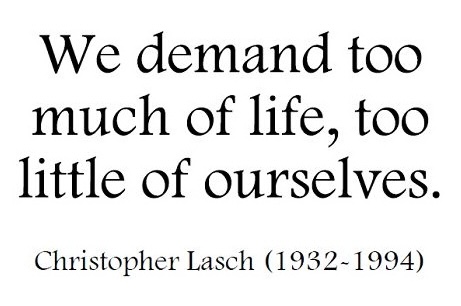
Lasch writes that “we demand too much of life, too little of ourselves.” We have outsized expectations and these two areas of life can’t handle that much stress. We need a more diversified portfolio. More areas to bear the weight, more connections to draw meaning from.
You know what happens when you stop expecting your spouse to be everything and you get more of your emotional needs met by friends? No, not divorce. Far from it.
Marriage researcher Eli Finkel reports that, over time, relationship satisfaction declines for most couples. But not for those who spread their social needs around. They don’t experience the dip. And they’re less likely to break up.
Don’t expect your job to be everything. And definitely don’t expect your partner to be everything. Let them be wonderful and imperfect.
(To learn how to have a happy marriage, click here.)
But where do so many of your real problems come from? It’s that voice in your head. (No, not my voice. I’m just in your head for the duration of this post.) I’m talking about that other voice…
Ditch Your Inner Critic
Lasch argued that as society became more individualistic, we dismantled a lot of the external structures that pushed us around. Yay! Freedom!
Eh, not so fast…
The external judges were nasty but at least they were out there. Getting rid of them didn’t silence the voice in our own heads. It made it louder. And that little jerk knows all your sensitive spots and works nights. And since it isn’t connected to any outside standard it generates new rules faster than you can violate them. It’s mental Calvinball.
But what should we replace it with? Gratitude and self-compassion.
Gratitude focuses attention outward. And it’s a natural remedy for Lasch’s narcissism because it admits that not everything good came from you and not all of it was earned. Studies show people who count their blessings are happier and more optimistic.
And then there’s self-compassion. Basically, it provides the benefits of self-esteem without the pressure to be better than others. Self-esteem says, “I’m awesome!” And then you’re stuck on an endless treadmill of proving that true until you collapse. By contrast, self-compassion says, “I’m still worth treating decently even when I’m not awesome.” This is important because you are frequently not awesome.
So, a few times a week, write down three things you’re grateful for. Just writing “Friends” won’t cut it. Be specific: “Nick called when I was spiraling.”
And next time you screw up, talk to yourself the way you’d talk to a friend who was down. Yeah, on the surface this sounds a little silly and embarrassing, like admitting you still own a fax machine, but it’s the better path. If beating yourself up actually helped, you’d be perfect by now.
(To learn how to be happier without really trying, click here.)
Lasch said we’re focused on image and status. How do we get out of the loop of comparing ourselves to others?
Anchor Your Worth In The Work
Open your phone and boom, there they are: the better people. Somebody you remember as a semi-sentient bong from college just started their second hedge fund. Right on cue, the Life Scoreboard appears. And you, my friend, are not topping the charts.
Yeah, yeah, social media is the devil, but Lasch was clocking this phenomenon before Mark Zuckerberg was born. So what’s the underlying issue?
When we don’t have an internal compass for what “a good life” means, we default to “better than them.” Better than somebody. Anybody. Please, just let there be one obvious loser doing worse than me so I can feel better about myself. Back in 1979 Lasch said people increasingly “wish to be not so much esteemed as admired… envied rather than respected.”
Because actually achieving success? It’s really inconvenient. Takes a lot of work. But the appearance of success? Ah, there you go. So much easier.
But that’s why it feels empty. You’re not invested in the work or really proud of the achievement. It’s all image and scoreboard.
Pick standards you respect even when nobody applauds. Then let those commitments hold you accountable.
Next? Lose yourself in the pursuit of that standard. Mihaly Csikszentmihalyi, a guy who has stymied more spell-checkers than any other person in human history, developed the concept of “flow.” It’s when you’re so absorbed in something you stop thinking about yourself and just mind-meld with the activity. It’s one of the things that make us happiest.
Instead of making you feel good because you’re impressive, it makes you feel good because you stop asking yourself, “Am I impressive right now?” In fact, your self-consciousness just shuts up. Which is wonderful because you’ve needed a break from yourself for a while.
(To learn more about flow and how it can make you happy, click here.)
And the final thing you need to do?
You need to not make it all about you anymore…
Invest In Somebody Who Comes After You
If your life is only about you, right now, then aging is just a long downward slide.
Where do all the attention and accolades go? To those young’uns. They inherit this world and they’ll take over while listening to music you hate. And some of them will actually improve the world, which is the truly unforgivable part.
When the younger people around you are thriving, you can see that as someone stealing your spot… or you can see it as something you helped make possible. Up to you.
You don’t get to be the protagonist in the movie forever. You become the mentor or you become the villain. I think you can guess which one is better.
In the social science literature, being a mentor has the fancy name of “generativity.” You don’t have to be a parent to do it. Children are certainly one method, and they are a very loud method that’s frequently sticky. But you can also be the Obi-Wan or the Morpheus to any younger person trying to find their way.
Back in 1992, researchers Dan McAdams and Ed de St. Aubin created the Loyola Generativity Scale, which is kinda like an online personality quiz but instead of insightfully discerning which Golden Girl you are, it assesses whether or not you’ll die unfulfilled. Their work showed that people higher in generativity were happier.
So pick a younger person to mentor. This is a chance to turn your old humiliations into “case studies.” Make introductions. And follow up. They’ll appreciate the help. And you’ll appreciate having someone who will make you proud and who will avenge you and smite your enemies after you’re past your peak smiting years.
(To learn how to create a life story that will make you happy, click here.)
Okay, we’ve covered a lot. Let’s round it all up and learn the humbling personal side of all this…
Sum Up
Here’s how to find meaning in life…
- Don’t Keep All Your Options Open. Commit: A life lived with your fingers always on Command-Z is a mistake. Choose and define yourself. A life has to narrow in order to deepen.
- Your Job And Partner Cannot Be Everything: You can’t cram all of life’s meaning into two tiny buckets. Meaning needs to be spread around. Like blame.
- Ditch Your Inner Critic: That awful voice in your head isn’t your conscience. The inner critic is what happens after your conscience gets bought out by a private-equity firm. Focus on gratitude and self-compassion.
- Anchor Your Worth In The Work: Set your own standard for success and find flow.
- Invest In Somebody Who Comes After You: Don’t you dare turn this into some cheap wellness hack. “Coach the intern and manifest optimal wellness!” is a sentence that needs to be buried in a shallow grave behind a coworking space.
Can I tell you something embarrassing?
Reading Lasch’s book felt like I was looking at an MRI of my own skull. I saw his vision of the fragile self and thought, “Crap. I am guilty of all of this.”
And I thought about the moments when this wasn’t true, when I wasn’t looking out hoping to find my desired self reflected back at me. And they were all really little moments. Nothing anybody would be impressed by.
Sitting next to my mother, who has dementia, reminding her of my name. Being silly while making dinner with somebody who loved me. Watching boredom become curiosity as I explained to a friend’s son that Greek myths were just as cool as superhero stories and that your homework doesn’t suck, your teacher does.
I forgot myself and my wants and needs and the stupid frustrations that too often make me feel one inconvenience away from becoming local news. And they’re the moments that, looking back, feel real.
Boundless freedom without pressure is a void. We resist the demands others place on us and forget that those things give life shape. They push in, you push out, and the boundary becomes who you are. Manage that right, thicken those bonds, and you don’t need to check your phone every 30 seconds to confirm you’re alive.
Reach out and let the world make demands on you. It’s all right if you’re disappointing and the effort is half-assed. You don’t have to do it all and you don’t have to do it perfectly. I know I can’t; I still have clothes in the dryer from yesterday.


