Behavioral Change Stairway Model: The FBI’s 5 Steps

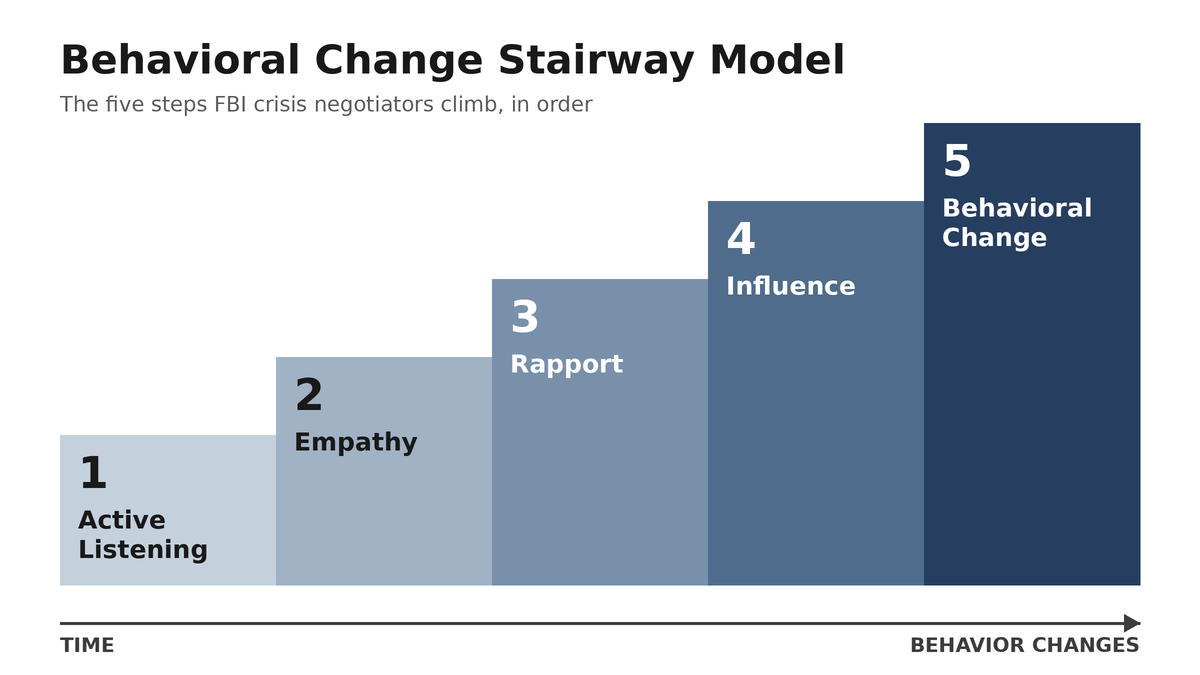
The Behavioral Change Stairway Model is how FBI hostage negotiators get people to change their behavior. It has five steps: active listening, empathy, rapport, influence and behavioral change.
It was developed by the FBI’s Crisis Negotiation Unit. Check out the chart:
It’s not something that’s only useful with barricaded perps wielding assault rifles — it can be applied to almost any form of disagreement.
How Does The Behavioral Change Stairway Model Work?
BCSM consists of five stages: active listening, empathy, rapport, influence, and behavioral change. Progression through these stages occurs sequentially and cumulatively. Specifically, the negotiator proceeds in sequence from Stage 1 (active listening) to Stage 5 (behavioral change). However, in order to establish rapport (Stage 3) with the subject, active listening skills (Stage 1) and empathy (Stage 2) must first be demonstrated (and maintained throughout) by the negotiator. As this process continues, influence (Stage 4) and behavioral change (Stage 5) follow. The latter stage refers to the successful resolution of the crisis that can only occur when, and only when, the previous stages have been carried out successfully.
Source: “Crisis (hostage) negotiation: current strategies and issues in high-risk conflict resolution” from Aggression and Violent Behavior 10 (2005) 533–551
What are these five stages?
1) Active Listening
This is the most important step — and the one most of us screw up. I’ve posted about this before here and here. I’ve covered many of the sub-techniques here.
2) Empathy
If you’re telling the person “No, no, no, you’re wrong and I’m right” you’re not showing empathy. (And hopefully you’re not in a situation with an armed felon.)
Empathy is a natural by-product of effective active listening. It implies an identification with, and understanding of, another’s situation, feelings, and motives.
3) Rapport
Empathy is what you feel. Rapport is when they feel it back. If you’ve executed the first two steps correctly and given it some time, you’ll get here. Easier said than done.
Until this stage of the BCSM, the relationship has been one-sided: the person in crisis has been talking and the negotiator has been actively listening and empathetic. As empathy is shown, rapport develops, which is characterized by increased trust and mutual affinity. Once rapport has been developed, the person in crisis is more likely to listen to (and accept) what the negotiator has to offer. At this stage, the negotiator, in collaboration with the subject, begins to build themes that provide face saving justifications, minimizations, or blending which serve as precursors to ending the crisis (Dalfonzo, 2002).
4) Influence
Until you have rapport, you can’t influence the other side because they’re not listening and trusting you. Once you have that connection, you can work on suggesting ideas and problem solving.
At this stage, a relationship has been established and the subject is willing to accept the suggestions of the negotiator as a prelude to behavior change. In negotiator parlance, the negotiator has earned the right to recommend a course of action to the subject as a result of collaborative problem solving. Now, the negotiator and subject work together to identify solutions and alternatives that are nonviolent and realistic.
5) Behavioral Change
Once the relationship has been established and influence achieved, the other side can act on the suggestions you’ve developed together (like putting the gun down and leaving the bank.)
Behavioral change will most likely occur only if the previous four stages have been successfully completed. Obstacles to reaching this final stage are usually: (1) the negotiator moving too rapidly through the stages, or (2) omitting stages in a misguided effort to end the crisis through (premature) problem solving. Again, the key to behavior change in crisis negotiation is achieving a positive relationship between the negotiator and subject via active listening, empathy, rapport, and behavior influence strategies and tactics. At this final stage, the subject will likely follow the negotiator’s suggestions to the extent that negotiator tasks in the previous stages have been effectively carried out.
How To Use It In An Everyday Argument
You don’t need a hostage taker. Most of us start at step 4: we skip the listening and go straight to “here’s why you’re wrong.” Start at step 1 instead. Here are the seven hostage negotiation tactics FBI negotiators use to do it.
Where Does The Behavioral Change Stairway Model Come From?
The FBI’s Crisis Negotiation Unit built it. The source most people cite is a 2005 paper by Gregory Vecchi, Vincent Van Hasselt and Stephen Romano. The quotes in this post come from it.
What Is The Behavioral Influence Stairway Model?
It’s the updated version, often shortened to BISM. Active listening stops being a step and becomes the foundation under all of them. In the newest version the steps are empathy, rapport, trust and influence, and they lead to behavioral change.
Sum Up
Here’s how the Behavioral Change Stairway Model works:
- Active listening: Hear them out, and show them you’re listening.
- Empathy: Understand where they’re coming from.
- Rapport: They start to trust you.
- Influence: Now you can suggest a way forward.
- Behavioral change: They act on it.
- Don’t skip steps: Rushing to problem solving is the usual reason it fails.
Related posts:
Hostage Negotiation Tactics: 7 FBI Techniques That Work
Chris Voss Interview: An FBI Hostage Negotiator’s Secrets
How To Be Persuasive: 7 New Secrets From Hostage Negotiation
NYPD Hostage Negotiators On How To Persuade People: 4 New Secrets
How You Can Learn The #1 Persuasion Technique of FBI Hostage Negotiators
Read next

Eric Barker is the author of Barking Up The Wrong Tree, a Wall Street Journal bestseller, and Plays Well With Others, a USA Today bestseller. Over 500,000 people have subscribed to his newsletter. More about Eric


