What makes us selfish: happiness or sadness?
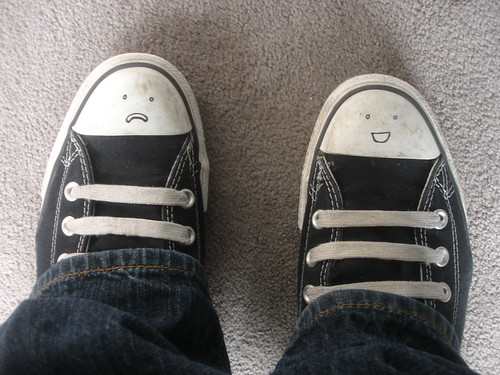
Looks like happy people are thinking about themselves. If you break the law, pray for a sad judge:
Does temporary mood influence how fair or selfish we are in interpersonal situations? These three experiments predicted and found that when people have the power to allocate scarce resources between themselves and others in the dictator game, positive mood increased selfishness, and sad mood produced greater fairness. In a public setting (Experiment 1), happy persons kept more raffle tickets to themselves when making allocations, and Experiment 2 confirmed this effect in the laboratory. Experiment 3 showed that mood effects on selfishness were strongest when the external norms for fairness were relaxed. The results are discussed in terms recent affect-cognition theories, suggesting that positive mood recruits more assimilative, internally focused processing, while negative affect promotes more externally oriented, accommodative processing and thus greater concern with social norms. The implications of the findings for everyday interpersonal decisions are considered.
Source: “When happiness makes us selfish, but sadness makes us fair: Affective influences on interpersonal strategies in the dictator game” from Journal of Experimental Social Psychology from Volume 46, Issue 3, May 2010, Pages 571-576
Over 500,000 people have subscribed. Get my free newsletter every two weeks here.
Related posts:
5 Scientific Secrets To Naps That Will Make You Happier And Smarter
4 Things Astronauts Can Teach You About A Good Night’s Sleep
These Six Things Will Bring You A Great Night’s Sleep
Read next

Eric Barker is the author of Barking Up The Wrong Tree, a Wall Street Journal bestseller, and Plays Well With Others, a USA Today bestseller. Over 500,000 people have subscribed to his newsletter. More about Eric


